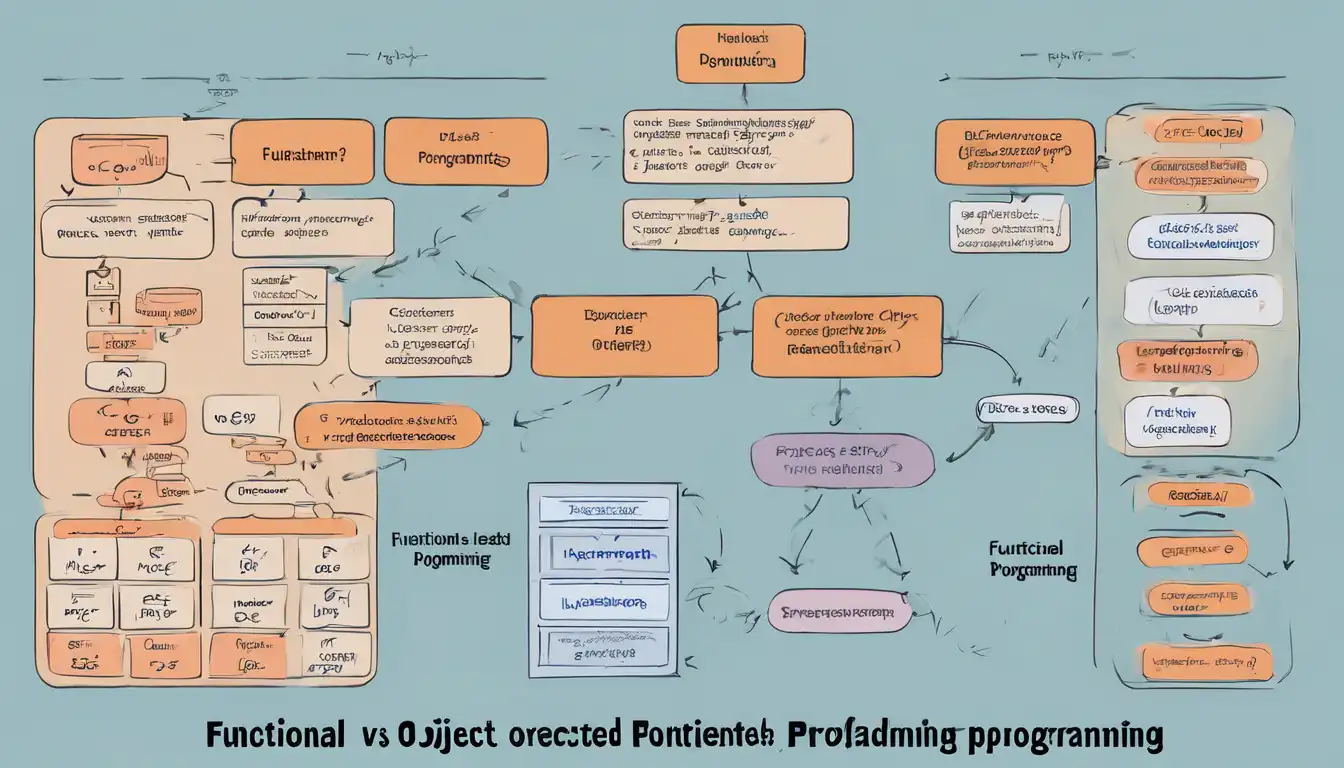
Introduction to Programming Paradigms
In the world of software development, understanding the differences between functional programming (FP) and object-oriented programming (OOP) is crucial for choosing the right approach for your project. Both paradigms offer unique advantages and challenges, making them suitable for different types of applications.
What is Functional Programming?
Functional programming is a paradigm that treats computation as the evaluation of mathematical functions and avoids changing-state and mutable data. It emphasizes the application of functions, in contrast to the imperative programming style, which emphasizes changes in state.
- Immutability: Data is immutable, meaning it cannot be changed after it's created.
- First-class functions: Functions are treated as first-class citizens, allowing them to be passed as arguments to other functions.
- Pure functions: Functions have no side effects and return the same output for the same input.
What is Object-Oriented Programming?
Object-oriented programming is a paradigm based on the concept of "objects", which can contain data and code: data in the form of fields, and code, in the form of procedures. OOP focuses on the objects that developers want to manipulate rather than the logic required to manipulate them.
- Encapsulation: Bundling of data with the methods that operate on that data.
- Inheritance: A mechanism where one class acquires the properties of another class.
- Polymorphism: The ability of an object to take on many forms.
Comparing Functional and Object-Oriented Programming
While both paradigms aim to make code more modular and reusable, they approach problems in fundamentally different ways. FP is more about "what to solve" using functions, whereas OOP is about "how to solve" by creating objects.
When to Use Functional Programming
Functional programming is ideal for applications that require high levels of concurrency or are data-intensive. It's also well-suited for mathematical computations where immutability and pure functions can lead to more predictable outcomes.
When to Use Object-Oriented Programming
Object-oriented programming shines in applications that involve complex systems with many interacting objects. It's particularly useful in GUI applications, simulations, and games where the state and behavior of objects are central.
Conclusion
Choosing between functional and object-oriented programming depends on the specific needs of your project. By understanding the strengths and weaknesses of each paradigm, developers can make informed decisions that lead to more efficient and maintainable code. For more insights into programming paradigms, explore our guide on programming paradigms.